


Behind the Shield: Rethinking Operator Safety in a High‑Radiation World
In nuclear medicine departments, interventional cardiology suites, research laboratories or nuclear facilities, professionals work every day in the presence of ionising radiation. For them, protection is not an abstract regulatory constraint; it is a matter of long-term health, precision of gesture and capacity to deliver care or research in the best possible conditions.
For more than fifty years, the French company based near Nantes, Lemer Pax, has made this reality its core mission. Behind the shields, mobile screens, hot cells and injection systems lies a very specific philosophy: protecting operators without sacrificing their comfort, dexterity or ability to innovate. This balance between safety and usability has become one of the company’s signatures.
From Lead Craftsmanship to Global Radioprotection Leader
Founded in 1970, Lemer Pax started with historic expertise in lead working. Over the decades, the company moved far beyond the role of a traditional manufacturer of shielding components. Today, it is recognised as a global leader in radioprotection, active on five continents and present wherever human beings are exposed to ionising radiation in a controlled, professional context.
Its activities span four main sectors:
- Medical: nuclear medicine, interventional cardiology and hybrid operating rooms
- Research: fundamental and applied research, including large international collaborations
- Industry: radiography, non-destructive testing, production and handling of radioactive sources
- Civil nuclear: fuel cycle, maintenance, decommissioning and nuclear logistics
The company’s motto, “Protecting Life”, encapsulates both its technical ambition and its ethical stance. In practice, this means designing systems that reduce dose exposure for operators while allowing them to perform complex tasks with high precision, day after day.
Operator Safety as a Design Starting Point
Many radioprotection devices on the market emerged as adaptations of basic shielding concepts: add thickness where radiation is present, and the problem is solved. Lemer Pax approaches things differently. Instead of starting from the material and asking what can be built with it, engineers begin with the operator’s gestures, workflows and constraints, then design protection around them.
This operator-centric perspective translates into several guiding principles:
- Anticipate exposure scenarios rather than simply comply with existing dose limits.
- Integrate ergonomics from the outset so that using protective equipment becomes intuitive, not a burden.
- Preserve clinical performance: diagnostic quality and procedural efficiency must not be degraded by protection.
- Support long-term practice by focusing on fatigue reduction, posture and musculoskeletal health.
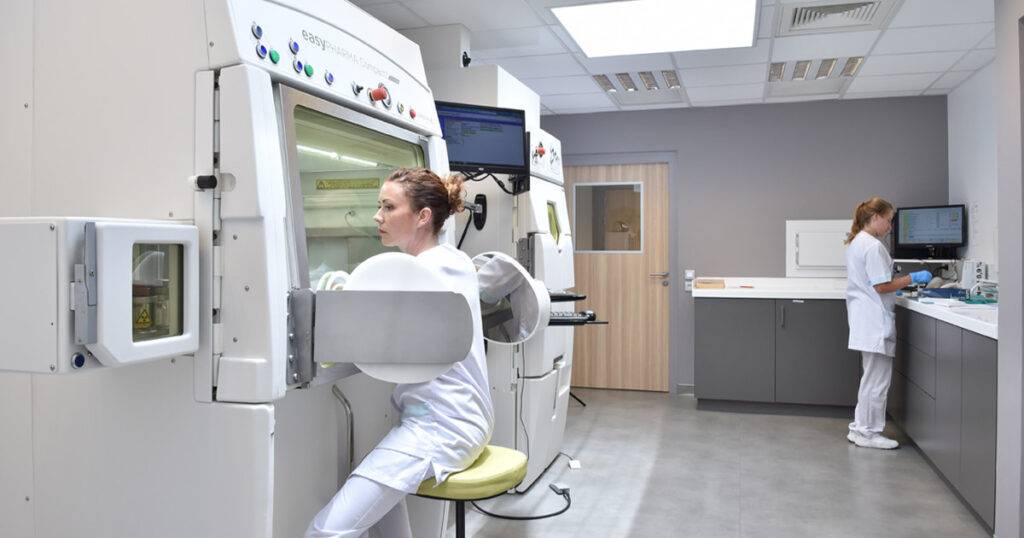
In nuclear medicine, this approach is visible in shielded injection systems, preparation enclosures and transfer devices that minimise direct handling of radiopharmaceuticals. In interventional cardiology, it appears in movable protective screens designed to integrate smoothly into complex, crowded cath labs.
Inside the Cath Lab: Protecting Those Who Stand All Day
Interventional cardiology is one of the most challenging environments in terms of radioprotection. Physicians often work standing for hours, wearing heavy lead aprons and operating under fluoroscopy. Over an entire career, cumulative exposure and musculoskeletal strain become serious issues.
In this context, Lemer Pax has focused on reducing both dose and physical load. Mobile screens, under-table protections and ceiling-suspended shields are designed not only to stop X-rays, but to:
- Provide maximum coverage of the most exposed anatomical zones (head, neck, thorax, gonads).
- Allow free movement around the patient and equipment, with minimal adjustment.
- Reduce the need for excessively heavy personal protective equipment, easing the physical burden on staff.
By combining collective protection (screens, structural shields) with lighter individual protections, the operator’s daily experience changes. Instead of “fighting” against the equipment to reach the patient or the fluoroscopy pedal, the cardiologist can move more naturally, while remaining within a protected “bubble”.
This shift may seem subtle, but it affects everything from procedural times to posture, concentration and ultimately professional longevity. For younger generations of interventionalists, who are increasingly aware of occupational health risks, the presence of high-performance protective systems is becoming a decisive factor when choosing a working environment.
Shielded Injection and Radiopharmaceutical Handling: The Invisible Workflows
Away from the spotlight of cath labs, nuclear medicine services face their own challenges. Every day, they prepare, transport and inject radiopharmaceuticals with specific activity levels and time constraints. Here again, Lemer Pax focuses on reducing exposure not only during the injection itself, but throughout the entire workflow.
Among the devices designed for these departments are:
- Shielded injectors that limit manual handling of syringes and vials, reducing hand and whole-body dose.
- Preparation enclosures that combine high-level shielding with visibility and precise manipulation.
- Mobile partitions and workstations that provide flexible protection where fixed infrastructure is not possible.
The aim is to ensure that each step—preparation, dosing, administration and waste management—takes place under optimal radiological safety conditions, without slowing down patient throughput or increasing the cognitive load on technologists.
Beyond Lead: Eco-Designed Materials and Sustainable Radioprotection
If lead has long been the benchmark for radiation shielding, its environmental and health impact, especially at end of life, raises legitimate concerns. Lemer Pax has therefore invested heavily in the search for alternative alloys and composite materials that offer high attenuation while being less toxic and easier to recycle.
The company now markets high-performance lead-free alloys integrated into numerous shielding products. These materials help:
- Reduce environmental impact associated with extraction, processing and disposal of classical lead.
- Facilitate waste management, a major challenge for hospitals and industrial sites.
- Open new design possibilities thanks to different densities, machinability and mechanical properties.
This approach is part of a broader eco-design strategy. By favouring short supply chains, optimising material use and designing products with maintenance and recyclability in mind, the company positions radioprotection within a more responsible industrial model.
Innovation at Scale: Patents, Partnerships and Agile R&D
With more than 80 patents filed internationally, Lemer Pax operates less like a conventional equipment supplier and more like a specialised innovation lab. The company employs over 140 collaborators, including engineers, physicists and specialists in ergonomics and industrial design, working closely with field users.
Academic institutions, hospitals and research centres are directly involved in the development cycle. Clinicians and researchers test prototypes, provide feedback on ergonomics and contribute to refining technical specifications. This iterative process allows rapid adaptation to emerging practices, such as:
- New interventional approaches guided by imaging.
- Development of novel radiopharmaceuticals with specific handling requirements.
- Increasing automation and robotisation in nuclear facilities.
This collaborative model has led to a range of niche, highly specialised products, but also to scalable platforms that can be adapted to different configurations and countries. It is through this mix of customisation and standardisation that the company maintains a significant share of its turnover in export markets.
On the Front Line of Big Science
Radioprotection is not limited to hospitals and industrial sites. Some of today’s most ambitious scientific experiments also rely on advanced shielding technologies. Lemer Pax participates in several large-scale international projects, including research efforts related to dark matter and fundamental physics.
In these contexts, shielding solutions must meet extremely demanding specifications:
- Ultra-low background radiation to avoid interfering with ultra-sensitive detectors.
- Complex geometries integrating multiple materials and access points for instrumentation.
- Long-term stability in often remote or hard-to-access infrastructures.
The experience acquired in these scientific collaborations feeds back into industrial and medical products, particularly in terms of material purity, mechanical precision and integration with sophisticated measurement systems.
“Le Monarch”: A Next-Generation Industrial Ecosystem
In 2024, the company’s growth took a tangible form with the move to its new headquarters, “Le Monarch”, in Carquefou, near Nantes. This site brings together under one roof research and development, design offices, production workshops and administrative departments.
Beyond the symbolic aspect, this consolidation has strategic implications. Having engineers, production teams and quality experts working side by side facilitates:
- Faster prototyping and testing of new shielding concepts.
- Tighter control of manufacturing quality, essential for safety-critical radioprotection equipment.
- Better traceability and compliance with international standards and regulations.
The site itself has been conceived as a demonstration of the company’s industrial vision: modern, efficient and aligned with its environmental commitments. From energy management to internal logistics, “Le Monarch” reflects a desire to build a long-term industrial ecosystem, not simply a production facility.
Why Comfort Matters as Much as Shielding Thickness
When discussing operator protection, it is tempting to focus solely on dose reduction. Yet the daily reality of professionals working with ionising radiation is more nuanced. Protective devices that are too heavy, difficult to position or poorly adapted to the workflow can lead to other risks: musculoskeletal disorders, fatigue, reduced concentration or even a temptation to bypass protection for the sake of speed.
This is where the Lemer Pax approach stands out. Comfort is not treated as an optional extra, but as a structural parameter of safety. A shield that is easy to handle is more likely to be used correctly, day after day. An ergonomic workstation reduces micro-errors and improves the reproducibility of procedures. In the long term, this integrated view of safety and comfort contributes to:
- Maintaining experienced staff in demanding specialties, rather than pushing them into early career changes.
- Improving the quality of care and research, by preserving the physical and cognitive capacities of operators.
- Reducing occupational health costs linked to chronic exposure and overuse injuries.
The shield, in this vision, is not just a barrier between radiation and the body; it is an interface between a professional and their work environment.
A Global Footprint Rooted in Local Responsibility
Despite its strong international presence, with exports to all five continents, the company remains anchored in its local ecosystem. Short supply chains, regional partnerships and the development of skills in and around Nantes are core elements of its strategy.
This combination of global impact and local responsibility is reflected in its certifications and quality systems. By aligning with the most stringent standards in terms of radiological safety and industrial processes, the company can guarantee that each product—whether destined for a university hospital in Europe, a nuclear research institute in Asia or an industrial site in North America—meets the same level of reliability.
Midway between a niche expert and a global industrial player, Lemer Pax illustrates how a specialised French SME can position itself at the forefront of a highly technical, regulated and sensitive field.
Radioprotection as a Standard of Excellence
Over more than five decades, the radioprotection field has gradually shifted from a compliance-driven mindset to a culture of excellence. Dose limits and regulations remain crucial, but for many operators, they are now only the baseline. The real question is how to push exposure as low as reasonably achievable while maintaining or enhancing performance.
In that regard, the approach developed by the French manufacturer is emblematic of a broader movement. By treating operator safety and comfort as two sides of the same coin, and by embedding eco-design and innovation into its core processes, the company contributes to redefining what “state of the art” radiological protection means today.
Behind every shielded injector, mobile screen or transport cask, there is a chain of decisions: which material to use, which posture to favour, which gesture to facilitate, which dose reduction to target. For those who stand day after day behind these shields—radiologists, cardiologists, nuclear medicine technologists, engineers, researchers—these decisions translate into very concrete outcomes: fewer millisieverts on their dosimeter, less pain at the end of a shift, more years of practice at the top of their profession.
In a world where the use of ionising radiation continues to expand—in medicine, industry and research—this integrated view of protection is likely to become not an exception, but a benchmark. Shielding will always be a matter of physics and materials. Yet, as demonstrated by this quiet industrial player from western France, it is also, and perhaps above all, a matter of people.